Mapping the grey horizon: The Demographic Transformation of Spain
Mapping the Graying Horizon: The Demographic Transformation of Spain
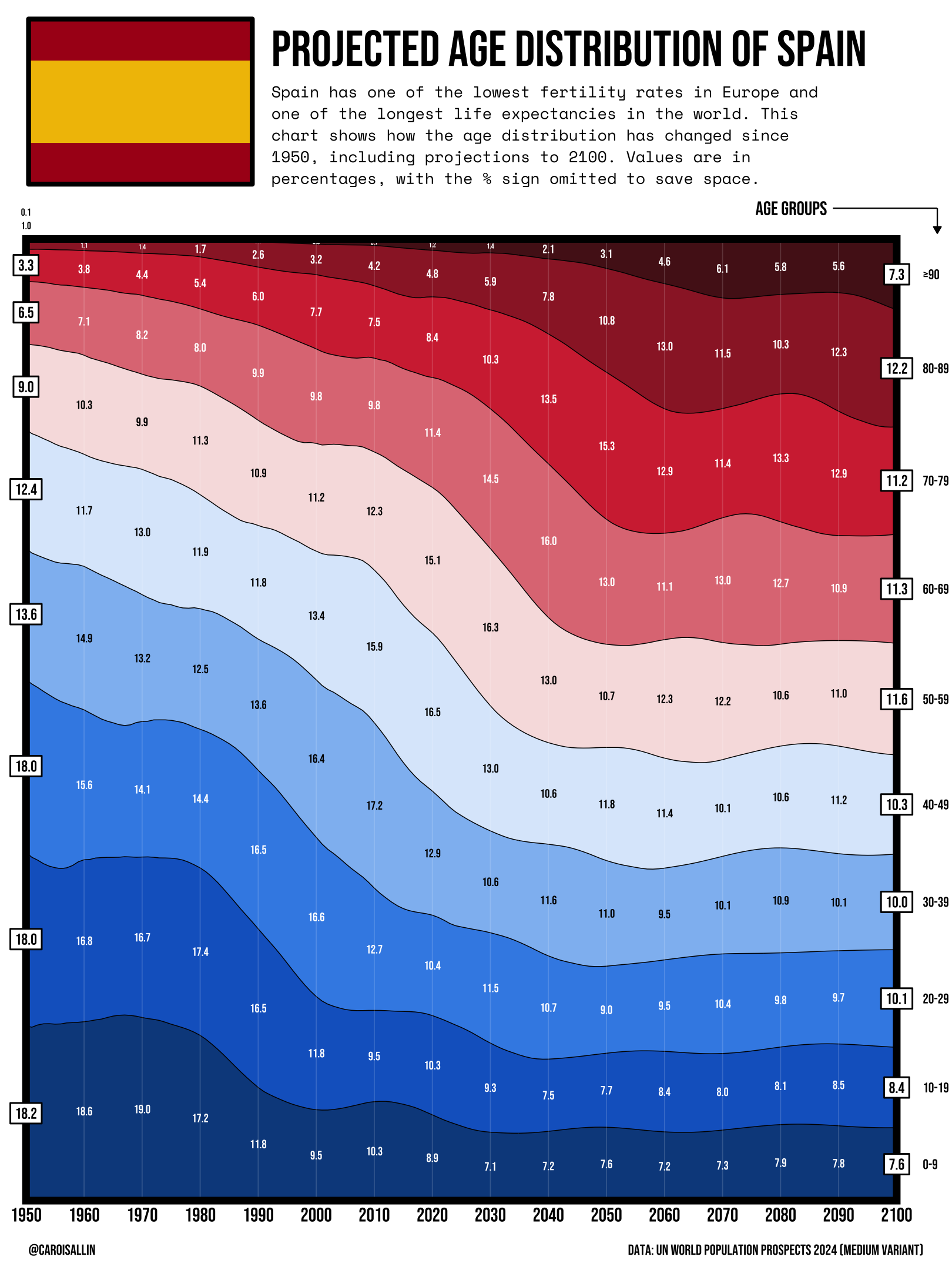
Demographic data rarely tells a simple story, but few visualizations capture a society’s profound structural evolution quite like a long-range age distribution chart. Looking at Spain’s trajectory from 1950 with projections extending toward 2100, we witness a dramatic transformation—shifting from a youthful, pyramid-shaped population to an inverted, top-heavy structure.
Driven by one of the lowest fertility rates in Europe and an extraordinary climb in life expectancy, Spain offers a clear lens into the future facing much of the developed world.
The Demographic Shift: Narrowing Bases and Expanding Summits
A glance at the bottom of the chart reveals the shrinking footprint of youth. In 1950, the youngest cohorts formed a wide, robust base, representing a society characterized by high birth rates. Over subsequent decades, that base steadily narrows. By the latter half of the 21st century, the proportions of children and young adults contract significantly, while the upper bands—representing citizens aged 80, 90, and beyond—thicken markedly.
Spain is living longer, but it is welcoming fewer newborns. This creates a “constrictive” population structure where older generations outnumber the young, redefining what the typical Spanish citizen looks like.
Economic Implications: Productivity, Public Finance, and Labor
The economic ramifications of this transition are immense and require careful structural adaptation:
- The Dependency Ratio: As the working-age population shrinks relative to the retired population, the dependency ratio climbs. Fewer active workers are left to support a growing cohort of retirees through tax contributions.
- Public Expenditure: Pension systems and healthcare infrastructure face mounting fiscal pressure. Policymakers must balance sustainable public budgets with the specialized medical and long-term care needs of an aging populace.
- Labor Market Dynamics: With domestic labor pools contracting, industries face potential workforce shortages. Sustaining economic productivity will likely demand increased investment in automation, lifelong reskilling, and managed legal immigration to maintain a dynamic labor force.
Conclusion
Spain’s population chart is much more than a historical record and a set of mathematical projections; it is a roadmap for policy and societal redesign. Successfully navigating this era requires proactive planning, economic modernization, and a reimagining of how communities support citizens across all stages of life.
How do you think urban infrastructure and local communities should adapt to better support an increasingly longevity-focused society?
Social Implications: Community, Family, and the Silver Economy
Beyond numbers and balance sheets, this demographic shift alters the social fabric of Spanish communities: